Variants
Diagonal Sudoku (Sudoku X): Rules & Strategy
Diagonal Sudoku, usually written Sudoku X, adds just one rule to the puzzle you already know — and that single addition changes how the whole board behaves. Here is the rule and the handful of ideas that make it click.
The one extra rule
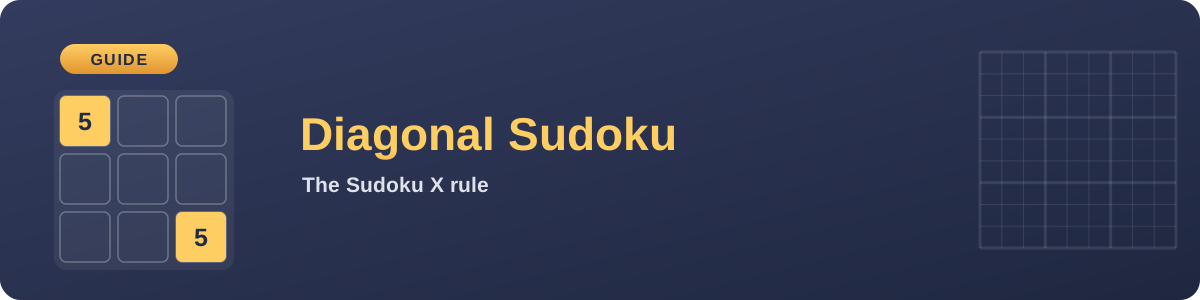
A Sudoku X board follows all three classic constraints: every row, every column and every 3×3 box holds 1 to 9 with no repeats. On top of that, the two long diagonals that run corner to corner must each contain all nine numbers as well. Those diagonals are usually shaded on the board so the extra rule stays in view. Nothing else changes, so every instinct you have from classic Sudoku still applies.
Why the diagonals help, not hinder
It sounds like more work, but the diagonal rule usually gives you more to go on, not less. Each diagonal behaves like an extra "line" across the grid, so a number that would be ambiguous by row, column and box alone is often pinned the moment you also check its diagonal. Treat each diagonal as if it were a tenth and eleventh unit, and scanning them becomes part of your rhythm rather than an afterthought.
Start at the centre
The single busiest square on a Sudoku X board is the centre cell, because it belongs to a row, a column, a box and both diagonals at once. That makes it one of the most constrained cells on the grid, so solving it early tends to unlock a cascade. The four corners are the next most useful, since each sits on a diagonal as well as its row, column and box. Work from these high-constraint cells outward.
Keep the two diagonals separate
A common slip is treating the two diagonals as interchangeable. They cross only at the centre cell, so resolving one tells you nothing directly about the other except through that single shared square. Track them as two independent units in your mind, and the extra rule becomes a reliable source of moves rather than a tangle.
A quick worked step
Imagine the main diagonal already holds every number except a 7, and the only empty cell left on it is where a row that also needs a 7 crosses. The diagonal demands a 7 there, the row allows it, and the box confirms it — three constraints agreeing at once. In plain Sudoku you might have had several candidates for that cell; the diagonal rule collapses them to one. These agreements are exactly why Sudoku X often solves faster than it looks.
Where it comes from
The diagonal variant is almost as old as the modern Sudoku boom: as the puzzle spread through newspapers in the mid-2000s, adding the two main diagonals was one of the earliest and most elegant twists, enough to refresh the solve without anything new to learn. It has been a fixture ever since, under the name Sudoku X for the shape the two diagonals trace across the grid.
Common mistakes to avoid
The one trap that catches most newcomers is forgetting the diagonals once a board gets busy. It is easy to place a number that is perfectly legal for its row, column and box yet quietly repeats on a diagonal you were not watching — and because the error can sit several moves back, it is painful to unwind. Build the habit of glancing at both shaded lines after every placement, especially near the centre and the corners. The second slip is assuming a diagonal behaves like a box: it does not bend or wrap, it is a single straight line of nine cells, so scan it end to end rather than in clusters.
Put it into practice on Diagonal Sudoku (Sudoku X). For more added-rule variants try Killer Sudoku, and when you want the pure original, Sudoku AZ and Expert Sudoku are always ready.
Frequently asked questions
What is Diagonal Sudoku?
Also called Sudoku X, it is classic 9×9 Sudoku with one extra rule: each of the two main diagonals must also contain the numbers 1 to 9 exactly once.
Does the extra rule make it harder?
It gives you more to track, but it also creates more deductions, so many players find it a satisfying step up rather than a harder slog.
Where should I start on a Sudoku X board?
The centre cell, which belongs to a row, a column, a box and both diagonals at once, then the four corners — they are the most constrained squares on the grid.
 Letter Sudoku
 Color Sudoku
 Fruit Sudoku
 Diagonal Sudoku
 Greater Than Sudoku
 Samurai Sudoku
 Chain Sudoku
 Flower Sudoku
 Daily Sudoku
 Killer Sudoku