Chains
The Skyscraper Technique
The Skyscraper is one of the friendliest single-digit patterns to learn: two strong links standing on a shared base, with two "roofs" that between them force a number out of the grid.
The shape of it
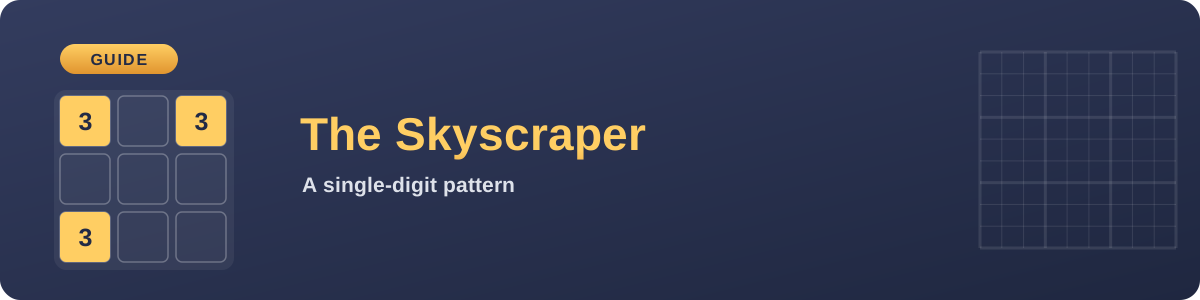
Work with one digit at a time. Find two rows in which that digit can go in exactly two cells each — a strong link in both. If one pair of those cells shares a column, that shared column is the base, like two towers rising from the same ground. The other two cells — one from each row, in different columns — are the roofs. That base-and-two-roofs picture is the whole pattern, and it also works with two columns sharing a row instead.
Why a number must leave
Here is the reasoning. In each row the digit sits in one of its two cells. If the digit avoids the base in one row, it must take that row's roof; the same is true of the other row. The two base cells share a column, so the digit cannot sit in both bases at once — meaning at least one of the two roofs must hold the digit. You do not know which roof, but you know one of them does. So any cell that sees both roofs cannot hold the digit, and you remove it.
Skyscraper versus X-Wing
The Skyscraper is a near relative of the X-Wing, and telling them apart clarifies both. An X-Wing needs the digit's two cells in each row to line up in the same two columns — a perfect rectangle. A Skyscraper is the "broken" rectangle: the two cells share only one column, at the base, while the roofs sit in different columns. That single mismatch is why the elimination targets the cells seeing both roofs, rather than clearing whole columns as an X-Wing does.
Hunting the pattern
Pick a digit that is already fairly well placed, so its remaining candidates are scarce, and make sure your candidate map is complete. Scan the rows for two that each pin the digit to just two cells, then check whether one cell from each falls in a common column. If so, you have a base; the two leftover cells are your roofs. Finally, look for any cell that lies in a unit with both roofs at once — that is where the digit comes off. If no cell sees both roofs, there is no elimination to make, and the pattern — however neat it looks — is inert on this board; note it and move to another digit. Confirming the payoff before celebrating the shape is a habit that saves a great deal of wasted effort.
A worked Skyscraper
Suppose the digit 3 sits in only two cells in row 2 and only two cells in row 7, and one cell from each shares column 4 — that is the base. The roofs are the other two 3-candidates: one in row 2, column 8, and one in row 7, column 1. At least one of those roofs is a 3. Now find a cell that sees both — for instance a cell in column 8 that also shares a box with the row-7 roof — and strike the 3 from it. One clean elimination, and singles you could not reach a moment ago start to appear.
Adding it to your toolkit
The Skyscraper is a fine first step into single-digit patterns before the longer chains of simple coloring. It is common enough to be worth actively looking for on hard grids and simple enough to spot with a little practice. Train your eye on Medium Sudoku, then put it to real use on Expert Sudoku, where a single Skyscraper can be the move that breaks the board. The classic grid is always ready at Sudoku AZ.
Frequently asked questions
What is a Skyscraper in Sudoku?
A Skyscraper is a single-digit pattern of two strong links that share one column (the base); the other two cells, the roofs, let you eliminate the digit from any cell that sees both.
How is a Skyscraper different from an X-Wing?
An X-Wing’s two cells share both columns to form a rectangle; a Skyscraper shares only one column, so the elimination targets cells seeing both roofs rather than whole columns.
When should I look for a Skyscraper?
On hard grids, using a digit that is already well placed so its remaining candidates are scarce.
 Letter Sudoku
 Color Sudoku
 Fruit Sudoku
 Diagonal Sudoku
 Greater Than Sudoku
 Samurai Sudoku
 Chain Sudoku
 Flower Sudoku
 Daily Sudoku
 Killer Sudoku